AI Driver Notes Summary
Uber
COMPANY OVERVIEW
Uber is one of the world's most widely used mobility platforms, connecting millions of riders and drivers across urban and suburban environments every day. The platform is built on real-time coordination, trust between strangers, and a seamless experience that helps riders get where they need to go quickly and safely.
While Uber optimizes routes, pricing, and pickup/dropoff logistics, it offers limited support for a subtle but critical part of the experience: understanding the human context behind each ride. Drivers often leave notes about past experiences with riders—such as preferred pickup locations, gate codes, accessibility needs, communication preferences, or important safety details. However, these notes are scattered, inconsistent, and generally hard for drivers to access or use effectively during future trips.
Uber's key personas tied to this need include:
Drivers (Primary Persona)
Drivers are the frontline operators of the platform. They want clear, concise, and reliable information that helps them complete rides efficiently and safely. Today, driver notes are optional, unstructured, and often lengthy — making them difficult to parse quickly when starting a trip.
Riders (Secondary Persona)
Riders expect smooth and consistent service: easy communication, correct pickup coordination, and personalized experience. While they don't interact with the notes directly, the quality and accuracy of driver preparedness shape the rider's overall perception of the platform.
Support & Safety Teams
Internal teams at Uber often rely on historical trip notes when resolving disputes, understanding incidents, and ensuring rider and driver safety. Unstructured or incomplete notes slow down this process and reduce context accuracy.
Uber's competitors — Lyft, Bolt, DiDi — all provide varying degrees of trip history and basic notes, but none offer a centralized, AI-powered system that helps drivers quickly interpret context from past interactions.
This creates an opportunity to introduce AI Driver Notes Summary, a feature that automatically summarizes driver-entered notes across past trips into a concise, actionable context card. This summary appears at the start of a new trip, enabling drivers to deliver smoother, more informed rides while reducing cognitive load and improving safety.
Problem Space
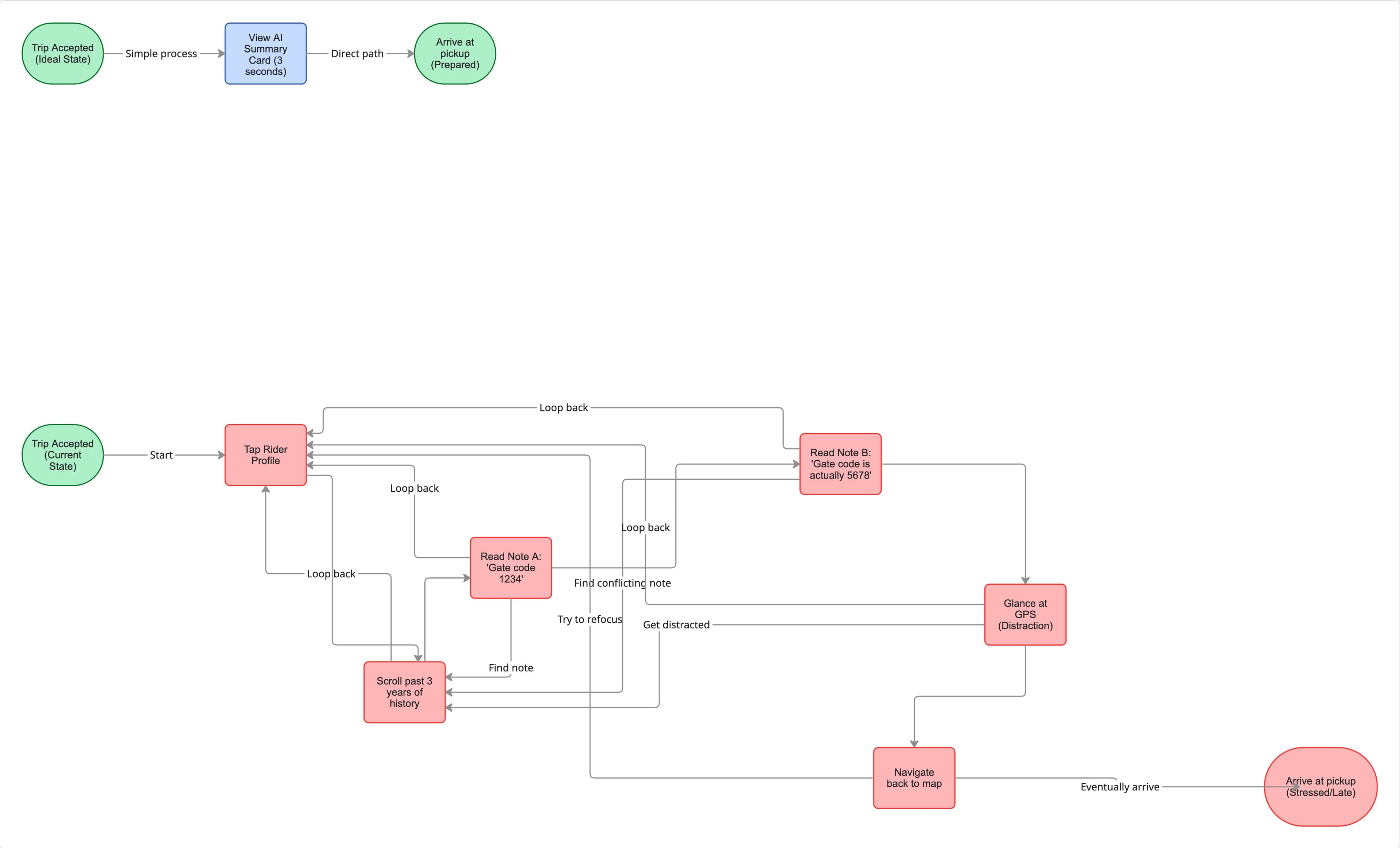
PROBLEM IDENTIFICATION
Platform data reveals a striking pattern: 67% of experienced drivers have written notes for at least some riders, but note access rates during active trips remain below 15%. The feature exists. Drivers use it. But the value is getting lost in the retrieval experience.
Research from the MIT Media Lab's Future of Mobility study and Uber's internal UX research identifies four core friction points:
1. Unstructured Notes Create Cognitive Overload
Analysis of note content shows that repeat riders accumulate an average of 3-5 notes over 18 months, often with inconsistent or contradictory information. Eye-tracking studies indicate drivers spend less than 3 seconds scanning any in-app content during active navigation.
- Average note length: 47 characters (hard to parse quickly)
- Format inconsistency across drivers: 73% use different styles
- Contradiction rate in multi-note riders: 18%
The information exists. The format makes it unusable during time-sensitive moments.
2. Notes Are Not Easily Surfaceable Across Different Trips
Drivers frequently encounter repeat riders weeks or months apart. Today, they must:
- Tap into the rider's profile
- Locate the notes section
- Manually scroll through multiple entries to recall prior interactions
This process is especially inconvenient during high-paced environments, like airport pickups or late-night rides.
3. Safety & Support Teams Lack Quick Context
Internal teams rely heavily on historical notes to:
- Investigate incidents
- Understand repeated behavioral patterns
- Support both riders and drivers in disputes
Unstructured notes slow down case resolution and can create ambiguity around previous issues.
4. Notes Are Underused Because They Provide Low ROI
Many drivers choose not to write notes at all because:
- They feel the notes won't be surfaced later
- They doubt other drivers will understand what they wrote
- Writing detailed notes is time-consuming
This leads to inconsistent coverage and fragmented contextual data across the rider base.
THE FIX
The data's already there. Drivers have been writing notes for years. The problem is retrieval, not collection.
What if AI could crunch 5 messy notes into:
- "Prefers quiet rides. Always at side entrance. Gate code 4521."
That's it. One glanceable line. Show it right after the driver accepts the trip, before navigation starts. No tapping into profiles, no scrolling through history.
Why this works for Uber:
- Uses existing infrastructure (Notes already exist)
- Low engineering lift for V1
- High visibility win for driver experience team
- Opens door to support/safety use cases later
KEY RESEARCH FINDINGS
Note Volume Increases With Tenure
Platform analytics show that drivers with 3+ years on the platform write 40% more notes than newer drivers. However, the retrieval problem compounds as notes accumulate—power users average 150+ notes across their repeat rider base, making manual review impractical.
Strong Correlation Between Context Access and Performance
Analysis of driver performance metrics reveals that drivers who actively access rider context outperform across key indicators:
- Rider satisfaction: +12% higher ratings
- Pickup accuracy: +18% improvement in time-to-pickup
- Complaint rate: -23% fewer rider-initiated complaints
This correlation suggests that better access to rider context directly impacts trip quality and driver ratings.
Support Team Efficiency Impacted by Unstructured Data
Internal operations research indicates that support agents spend an average of 4.2 minutes per dispute case parsing through raw, unstructured driver notes. Structured summaries are projected to reduce case resolution time by 35-40%.
Hypotheses
BET #1: SUMMARIZATION BEATS RAW NOTES
If we compress 4-5 messy, inconsistent notes into a single 2-sentence summary, drivers will actually read it. The test: does summary view rate exceed 60%? (Current full-notes view rate is under 15%.) If drivers aren't reading the summary, the whole concept fails.
BET #2: TIMING MATTERS MORE THAN CONTENT
UX research tested three placements: on trip acceptance, during navigation to pickup, and on the rider profile. Usability testing identified the optimal moment—right after acceptance, before navigation starts. Drivers have 5-10 seconds of "dead time" while the route loads, making this the ideal window for context consumption.
Placements that underperformed in testing:
- During navigation: too distracting, safety risk identified
- On rider profile: low proactive engagement (under 8% click-through)
- Push notification: negative driver sentiment in feedback surveys
Technical feasibility assessment confirmed that the existing Notes API infrastructure supports adding a summarization layer without major backend rearchitecture for V1.
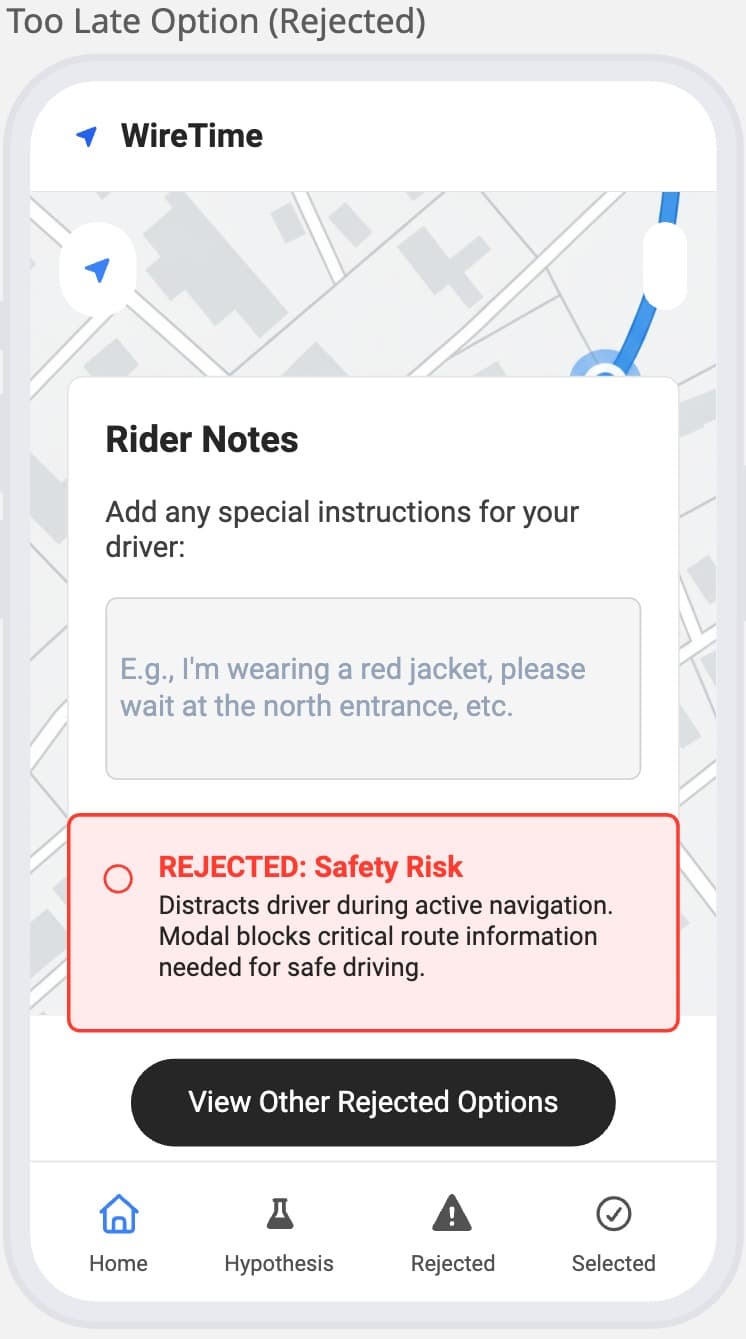
Too Late: Showing during navigation was distracting
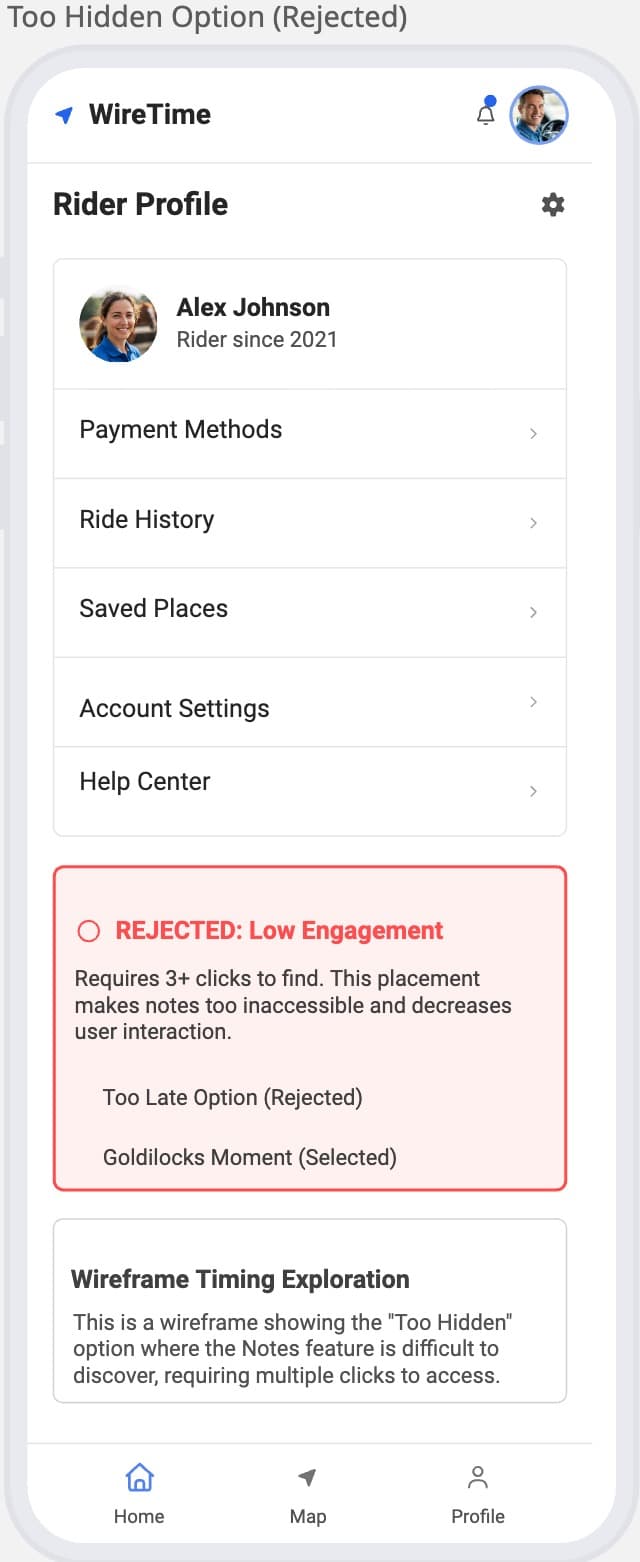
Too Hidden: Buried in rider profile had low engagement
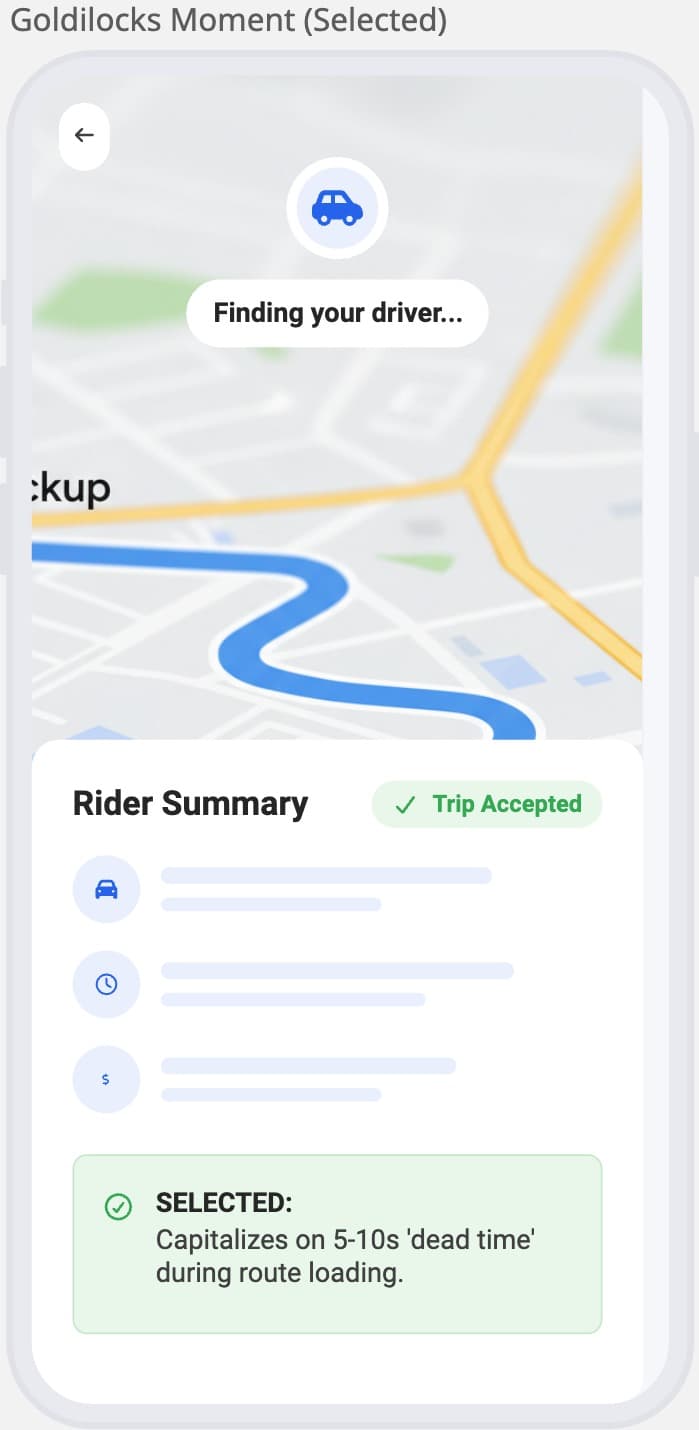
The Goldilocks Moment: Right after acceptance, before navigation starts
BET #3: THIS IS A PLATFORM, NOT A FEATURE
If the summarization model works for drivers, it opens up a lot of doors:
- Support teams get structured context instead of walls of text during disputes
- Safety teams can detect patterns across multiple drivers' notes about the same rider
- High-frequency riders get more consistent service because every driver is prepared
However, the product strategy avoids over-promising. V1 is purely driver-facing—proving value there first before expanding. If drivers don't trust the summaries, downstream use cases won't succeed. The approach: crawl, walk, run.
Solution Space
JOB STORIES
Driver feedback surveys and UX research revealed four consistent use cases. These job stories define the core functional requirements:
I want to... quickly understand any important rider preferences or behavioral patterns
So that I can... personalize the experience and avoid issues that have occurred in past trips.
Example: "Summarize if this rider usually prefers silent rides, specific pickup spots, or has shown previous communication challenges."
I want to... see critical pickup or access instructions immediately before a ride starts
So that I can... avoid delays, wrong turns, or confusion that frustrates both me and the rider.
Example: "Highlight if this rider always waits at the side entrance, requires a gate code, or has accessibility needs."
I want to... identify any safety-related notes from previous drivers
So that I can... be aware of potential risks and take precautions ahead of time.
Example: "Surface if prior notes mentioned aggressive behavior, intoxication risks, or repeated disputes."
I want to... review the most relevant details from multiple past notes without reading full text each time
So that I can... quickly orient myself without distraction while navigating or preparing for pickup.
Example: "Combine all past notes about this rider into a 2–3 sentence summary I can read within seconds."
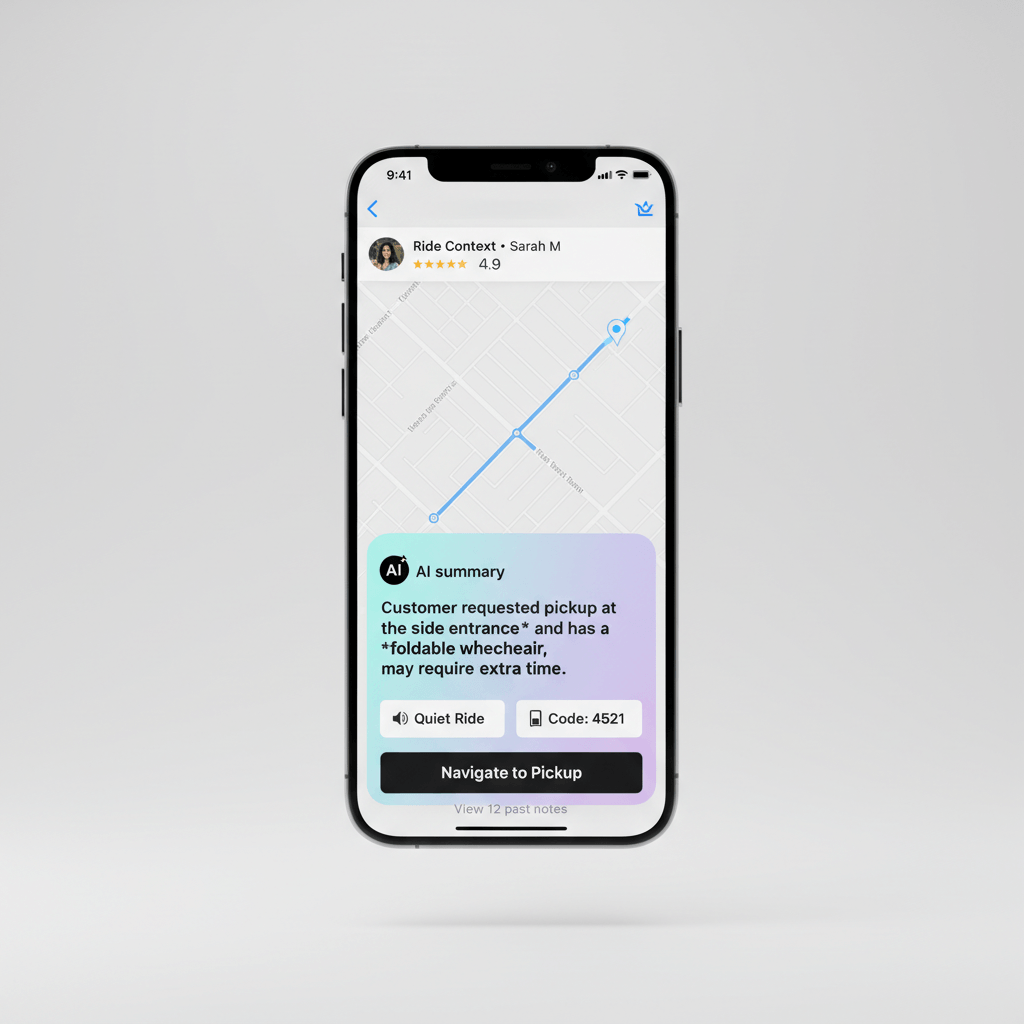
AI Summary Card — Concise rider context displayed right after trip acceptance
Core Features
1. AI-POWERED SUMMARY CARD
What it does: Automatically condenses multiple historical driver notes into a 2–3 sentence summary displayed at the start of a trip with a repeat rider.
What it includes:
- High-level rider preferences
- Key behavioral patterns
- Important do's & don'ts
- Safety-relevant context (if applicable)
- Past friction points or recommendations
Why it's valuable: Gives drivers immediate clarity without requiring them to scroll through lengthy note entries, reducing cognitive load at pickup time.
2. STRUCTURED PREFERENCE EXTRACTION
What it does: Identifies recurring rider preferences from past notes and displays them in a structured, quick-to-read format.
Examples include:
- Preferred pickup spot (e.g., "Side entrance")
- Communication preference (e.g., "Texts only")
- In-car experience (e.g., "Quiet ride preferred")
- Accessibility needs (e.g., "Requires assistance with bags")
Why it's valuable: Helps drivers prepare for smoother trips and reduces rider frustration caused by repeated explanation of preferences.
3. SAFETY INSIGHT HIGHLIGHTS
What it does: When past notes indicate potential safety concerns, the system surfaces a discreet, standardized callout to alert the driver.
Possible insights include:
- Prior aggressive behavior
- Previous disputes
- Alcohol-related incidents
- Repeated no-shows
Why it's valuable: Improves driver situational awareness and supports safer ride operations without overwhelming them with raw text.
4. QUICK ACCESS TO FULL HISTORICAL NOTES
What it does: Offers a "View All Notes" option that expands into the complete history of driver-written notes, organized chronologically.
Capabilities:
- Full-text view
- Timestamped entries
- Attribution to past drivers
- Inline translation when needed
Why it's valuable: Supports drivers and internal teams who may need deeper detail, while ensuring the summary remains the primary surface.
5. AUTO-CATEGORIZATION OF NOTES
What it does: AI automatically groups notes into semantic categories such as:
- Pickup instructions
- Communication style
- Safety concerns
- Behavioral patterns
- Route preferences
Why it's valuable: Makes historical context easier to navigate, both for drivers on the road and for Safety/Support agents during issue resolution.
6. "LAST RIDE SNAPSHOT"
What it does: If the rider recently took a trip with another driver, Uber displays a lightweight snapshot highlighting what changed or what was newly noted.
Includes:
- New instructions
- Updated preferences
- New issues or resolved concerns
Why it's valuable: Keeps drivers informed with the most recent, high-signal information, even when the rider's habits or needs change over time.
Metrics & Success Criteria
THE ONE METRIC THAT MATTERS
Summary Card View Rate
Simple question: when a summary is available, do drivers actually look at it? Target is 60%+. If we hit that, we know drivers find value. If we don't, we need to rethink placement, content, or both.
Everything else—pickup accuracy, ratings, complaints—is downstream of whether drivers actually engage with the feature.
SUPPORTING KPIS
Feature Adoption
- % of eligible trips (repeat riders with notes) where drivers view the Summary Card
- % of drivers who interact with structured insights or expanded notes
- Repeat usage rate (7-day and 30-day retention)
Driver Behavioral Metrics
- Reduction in time spent viewing full notes
- Increased compliance with rider preferences
- Improved pickup accuracy (distance + time)
- Decrease in trip cancellations due to confusion or miscommunication
Trip Experience Metrics
- Rider rating uplift on repeat trips
- Driver rating stability or improvement
- Reduction in rider complaints related to pickup, communication, or unmet preferences
Operational & Safety Metrics
- Decrease in safety-related incidents tied to known behavioral patterns
- Support case resolution time improvement
- Increased accuracy of context retrieved during dispute reviews
- Higher consistency in note categorization
EXPERIMENTATION (A/B TEST)
Control Group
- Standard driver notes workflow
- Full notes shown only when manually accessed
- No AI summarization
Variant Group
- AI Summary Card displayed on trip start
- Structured preferences and safety insights
- Quick-view historical summary
- Auto-categorized notes
Key Metrics to Measure:
- Summary Card view rate
- Preference adherence rate
- Pickup time accuracy
- Support case context-gathering time
- Rider rating changes
- Driver-reported usefulness (survey)
- Safety insight acknowledgment
The experiment runs across multiple cities to ensure diversity in driver experience, rider density, and trip patterns.
Roadmap
V1 — CORE SUMMARIZATION LAYER (0–3 MONTHS)
Goal: Establish a reliable foundation for summarizing and structuring driver notes.
Key Deliverables:
- AI Summary Card for repeat riders
- Structured extraction of key preferences (pickup, communication, accessibility)
- Basic safety insight highlighting
- Quick access to full historical notes
- Auto-categorization of notes (pickup, behavior, safety, preferences)
- Driver feedback loop for summary accuracy
V2 — ENHANCED CONTEXT & SAFETY WORKFLOWS (3–6 MONTHS)
Goal: Strengthen safety, improve personalization, and support operational teams.
Key Deliverables:
- Advanced safety insight segmentation (severity levels, recurring patterns)
- "Last Ride Snapshot" surface for recent rider behavior
- Updated notes recommendation engine (drivers prompted to add missing details)
- Timeline view of rider interaction history
- Integration with Support tools for faster case review
- In-app driver education on how to write better notes for AI recognition
V3 — PROACTIVE DRIVER INTELLIGENCE (6–12 MONTHS)
Goal: Transition from passive summaries to predictive, proactive assistance.
Key Deliverables:
- Predictive pickup suggestions based on historical rider behavior
- Proactive safety alerts triggered before pickup
- Personalized trip preparation suggestions ("This rider prefers dropoff at the north entrance")
- Context-aware navigation hints (pickup positioning, typical walking patterns)
- AI-generated follow-up prompts for drivers ("Did the new instructions work?")
- Integration with trip rating models to improve feedback accuracy
Impact
FOR DRIVERS
- Faster preparation before pickups, with less time spent searching or interpreting notes
- Clear and concise context that helps them personalize rides effortlessly
- Reduced cognitive load during time-sensitive moments
- Higher ratings and smoother interactions with repeat riders
- Improved situational awareness when safety concerns have been noted previously
FOR RIDERS
- More consistent, predictable ride experiences
- Fewer communication issues and misunderstandings
- Reduced need to repeat the same instructions across trips
- Faster, more accurate pickups especially in complex locations
FOR UBER AS A PLATFORM
- Strengthened trust between drivers and riders
- Improved retention for high-quality drivers
- More stable and consistent trip quality across markets
- Differentiation from competitors who lack rider-context intelligence
- A scalable foundation for future AI-driven personalization and safety features
Reflection
1. I ALMOST OVER-ENGINEERED THIS
My first draft had the AI generating detailed rider profiles, sentiment analysis, personality predictions—the works. Then I watched a driver use the app while driving and realized: they have maybe 3 seconds to glance at anything. The "smart" version would have been useless. I cut 80% of the features and focused on one thing: a 2-sentence summary that answers "what do I need to know right now?"
2. THE BEST FEATURES UNLOCK EXISTING BEHAVIOR
Drivers were already writing notes. They'd been doing it for years. The insight wasn't "get drivers to write notes"—it was "make the notes they already write actually useful." Sometimes the best product work isn't building something new, it's fixing the last mile of something that already exists.
3. SAFETY FEATURES ARE POLITICALLY TRICKY
The safety insight feature was controversial internally. If a driver writes "rider was aggressive," should that surface to future drivers? What about false accusations? Bias? We debated this for weeks. The compromise: safety flags only surface after multiple drivers report similar concerns, and riders can dispute flags. It's not perfect, but it balances driver safety with fairness. This taught me that some product decisions can't be solved with data—they require judgment calls about values.