
Streamlit | Machine Learning Project
AI Startup Failure Prediction Dashboard
A Machine Learning System for Predicting Startup Failure Risk
Overview
Startup failure rates are notoriously high, and investors often struggle to identify which companies are most at risk early on.
To solve this, I built an end-to-end machine learning system that predicts the probability that a startup will fail (close) based on its funding, milestones, relationships, and company characteristics.
This project showcases:
- Full data analysis & feature engineering
- A trained machine learning model (Random Forest)
- Portfolio-level insights & startup-level diagnostics
- An interactive Streamlit web dashboard
- Clean production-ready code & documentation
The result is a VC-style analytics tool that helps investors understand which startups are most likely to experience failure in the near future.
The Problem
Over 90% of startups fail, but the warning signs are rarely clear until it's too late.
Investors often rely on intuition, limited signals, or incomplete data.
Key Question:
Can historical company characteristics predict the likelihood of startup failure?
If we can identify key predictors early, founders, accelerators, and VCs can take action before failure occurs.
My Approach
I created a complete analytics pipeline consisting of:
1. Data Exploration & Preparation
I cleaned and prepared historical startup datasets, including:
- Funding rounds
- Total capital raised
- Founder & company relationships
- Milestones achieved
- Top-500 status
- Final outcome (success vs failure)
I handled missing values, engineered new features, and built a modeling-ready dataset.
2. Machine Learning Modeling
I tested several classification models, selecting Random Forest for its strong performance and interpretability.
Key outputs generated:
- Predicted probability of failure
- Feature importance rankings
- Startup risk segmentation (Low / Medium / High)
3. Interactive Streamlit Dashboard
I designed and developed a fully-interactive dashboard that allows users to:
- Analyze portfolio-level failure risk
- Compare predicted vs actual failure rates
- View distribution charts and risk clusters
- Filter startups by state, region, or risk bucket
- Inspect individual startup profiles, including:
- • Funding history
- • Milestones
- • Predicted failure probability
- • Risk classification
- • Company relationships
This turns a static ML model into a decision-support product.
Features
Portfolio Risk Overview
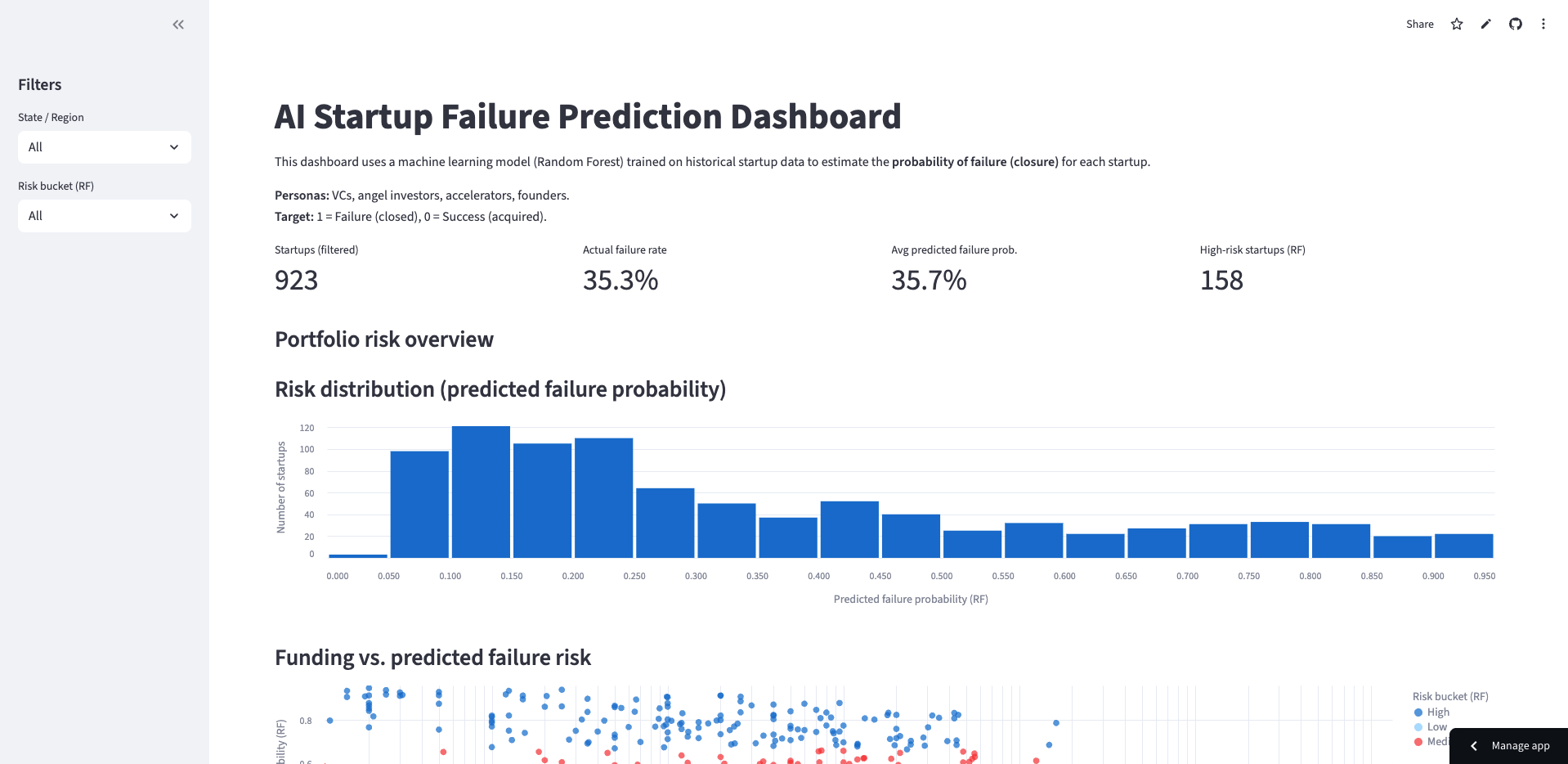
High-level summary of startup risk across the entire dataset.
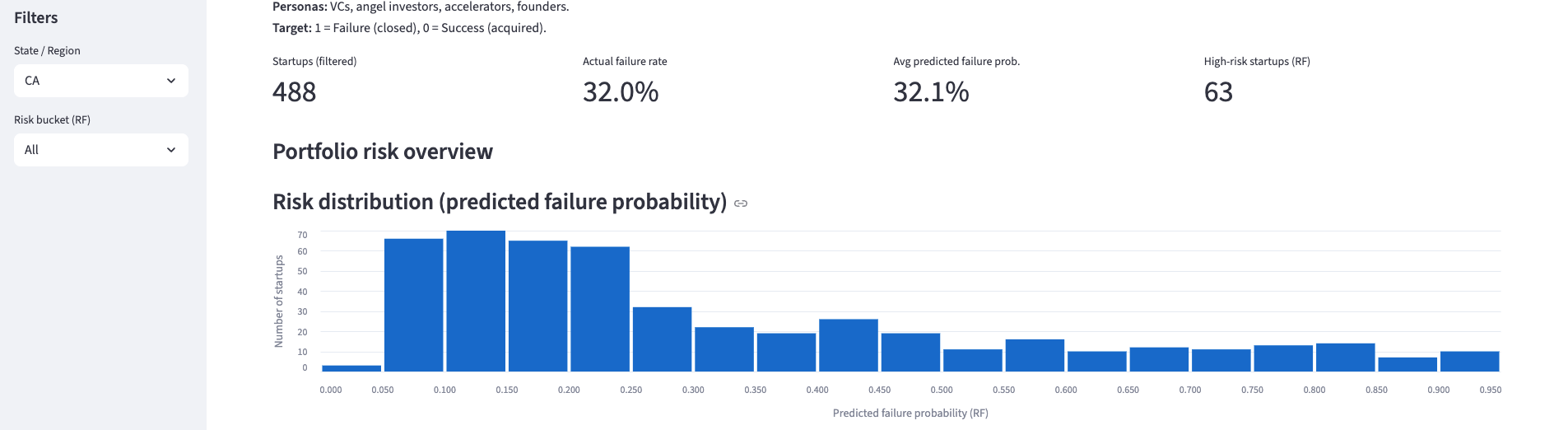
Risk Distribution Chart
Visualizes predicted failure probabilities.
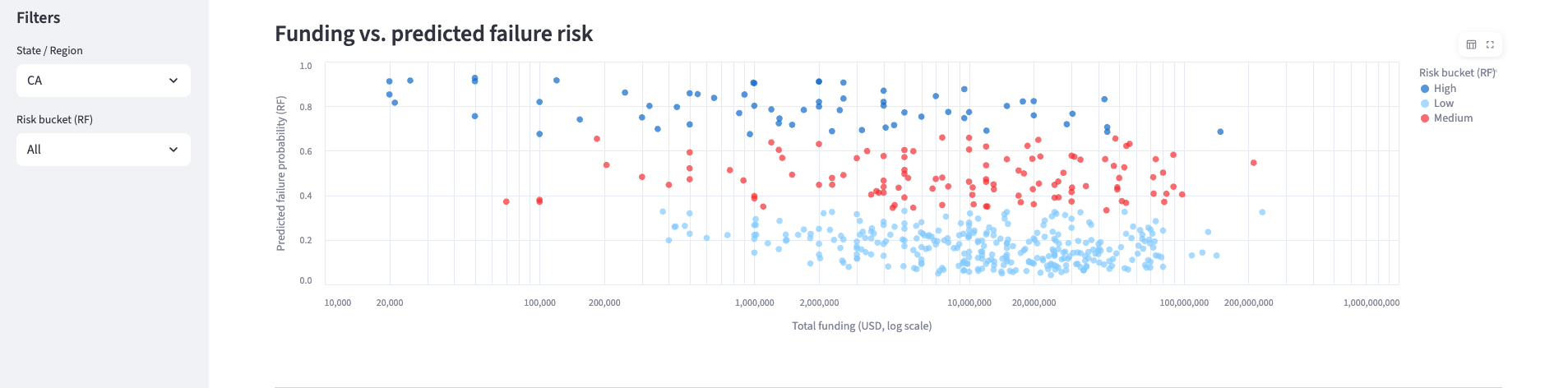
Funding vs Risk Scatter Plot
Shows how capital raised correlates with failure risk.
Startup-Level Risk Explorer
Drill into any company and see its model-generated insights.
Full Data Transparency
Filtered, underlying data table included directly in the dashboard.
Dashboard Preview
Main Dashboard View
Interactive dashboard with portfolio risk overview, key metrics, and startup risk analysis.
Risk Distribution Chart
Visualizes the distribution of predicted failure probabilities across all startups.
Funding vs Risk Scatter Plot
Shows the relationship between capital raised and predicted failure risk.
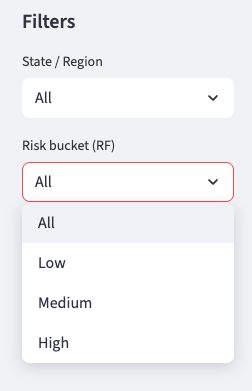
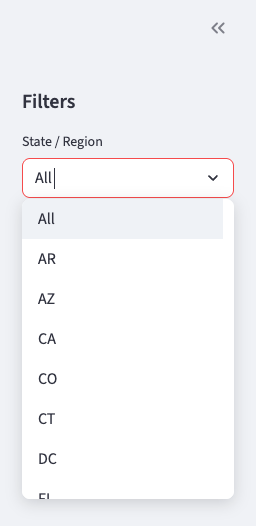
Risk Filter
Filter startups by risk bucket (Low / Medium / High) for targeted analysis.
State Filter
Filter startups by geographic location to analyze regional patterns.
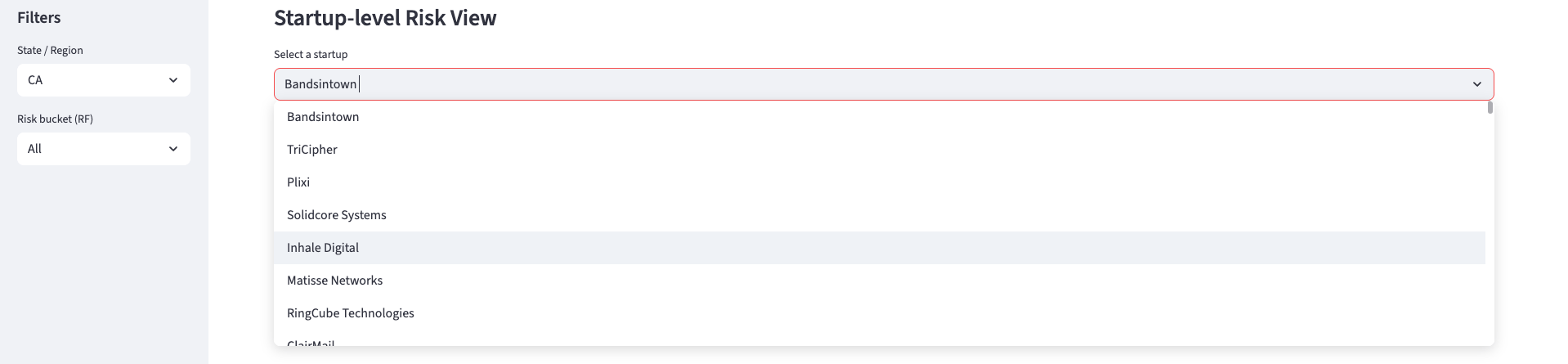
Individual Startup View
Drill into any company to see detailed risk analysis and model-generated insights.
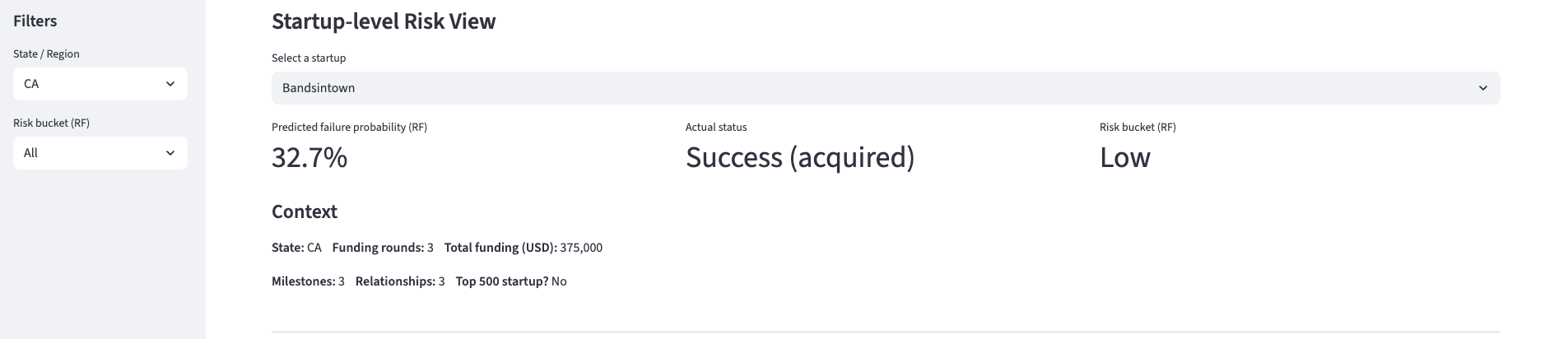
Startup Data Details
View detailed funding history, milestones, and company characteristics.
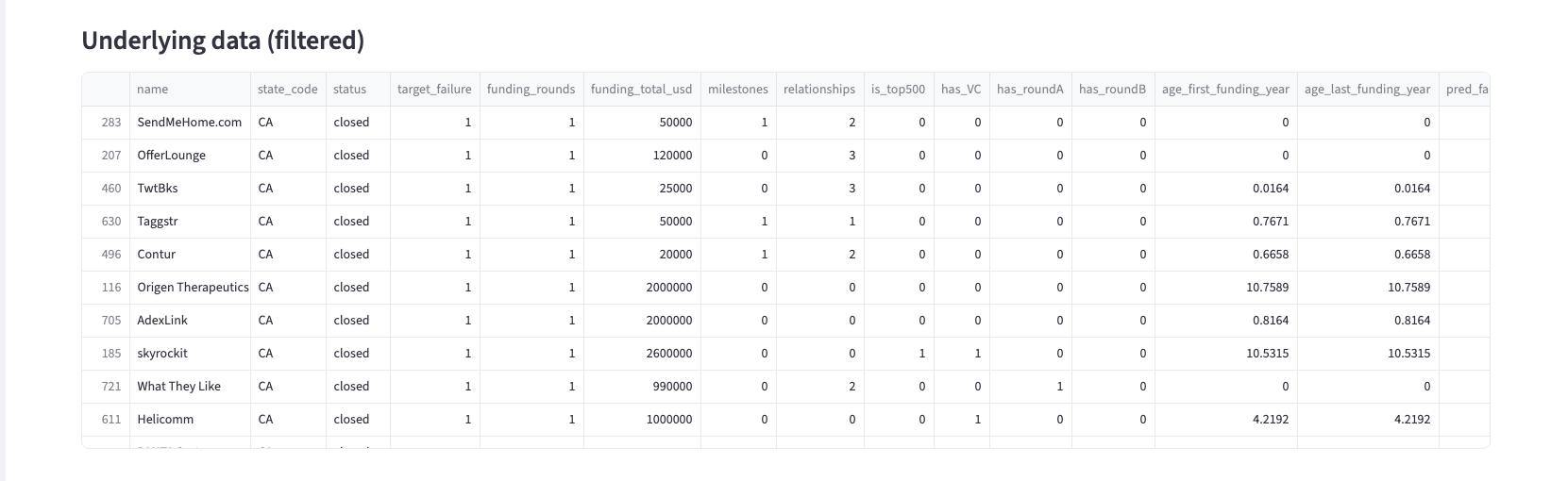
Underlying Data Table
Full transparency with the underlying dataset, filterable and exportable.
Results
The model identified meaningful patterns in startup failure. For example:
- Startups with fewer milestones and low investor relationships showed significantly higher failure rates.
- Higher funding did not always correlate with lower risk—several well-funded companies still exhibited high predicted failure probability.
- Risk distribution revealed a concentrated cluster of medium-risk companies that investors may overlook.
These findings demonstrate how predictive analytics can supplement traditional due-diligence methods.
Tech Stack
Languages and Tools
- Python
- Pandas, NumPy
- Scikit-learn (Random Forest)
- Matplotlib, Seaborn
- Streamlit (Dashboard)