
Streamlit | Machine Learning Project
Customer Churn Prediction
Predicting Customer Attrition Using Machine Learning & Analytics
Overview
Customer churn is one of the most important metrics for subscription-based businesses. Retaining a customer is significantly cheaper than acquiring a new one, and understanding why customers leave can directly improve revenue and long-term growth.
In this project, I built a complete end-to-end churn prediction system using the Telco Customer Churn Dataset. The project includes exploratory data analysis, feature engineering, model development, and an interactive Streamlit dashboard that allows users to explore churn patterns and predict the churn probability for any customer profile.
This project demonstrates my ability to:
- Analyze complex customer behavior data
- Build predictive models that support business decisions
- Design dashboards that communicate insights clearly
- Deploy analytical applications for real-world use
The Problem
Telecom companies lose substantial revenue every year due to customer churn. Understanding what factors contribute to customer attrition—and which customers are most likely to churn—enables companies to take proactive action.
The key business questions:
- What patterns differentiate customers who churn from those who stay?
- Which customer characteristics are the strongest predictors of churn?
- Can we build a model that accurately predicts whether a customer is at risk?
- How can insights be visualized and used to support decision-making?
My Approach
1. Exploratory Data Analysis
I analyzed customer demographics, contract types, billing information, tenure, internet service types, and more to uncover patterns related to churn.
Key insights included:
- Month-to-month customers churn at much higher rates
- Customers with fiber-optic internet show higher churn
- Short-tenure customers are the most vulnerable
- Electronic check users churn more than users with automatic payment methods
Charts were used throughout to visualize churn distribution and segment-level differences.
2. Feature Engineering
To improve model performance and interpretability:
- Created tenure groups ("0–12", "13–24", "25–48", "49+")
- Encoded categorical variables
- Cleaned and imputed missing values
- Generated additional features related to billing behavior
3. Model Development
I built and compared multiple machine learning models, including:
- Logistic Regression
- Random Forest Classifier
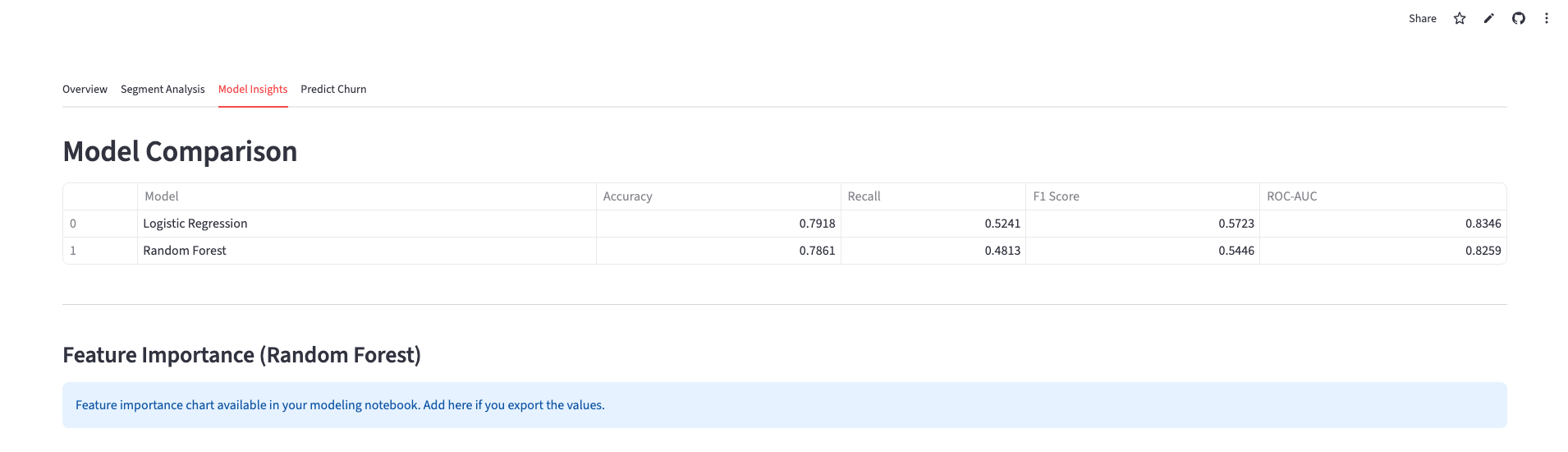
The models were evaluated using accuracy, recall, F1 score, and ROC-AUC. Logistic Regression performed the best overall and offered strong interpretability—critical for business stakeholders.
4. Interactive Dashboard
I developed a Streamlit application with four main sections:
Overview
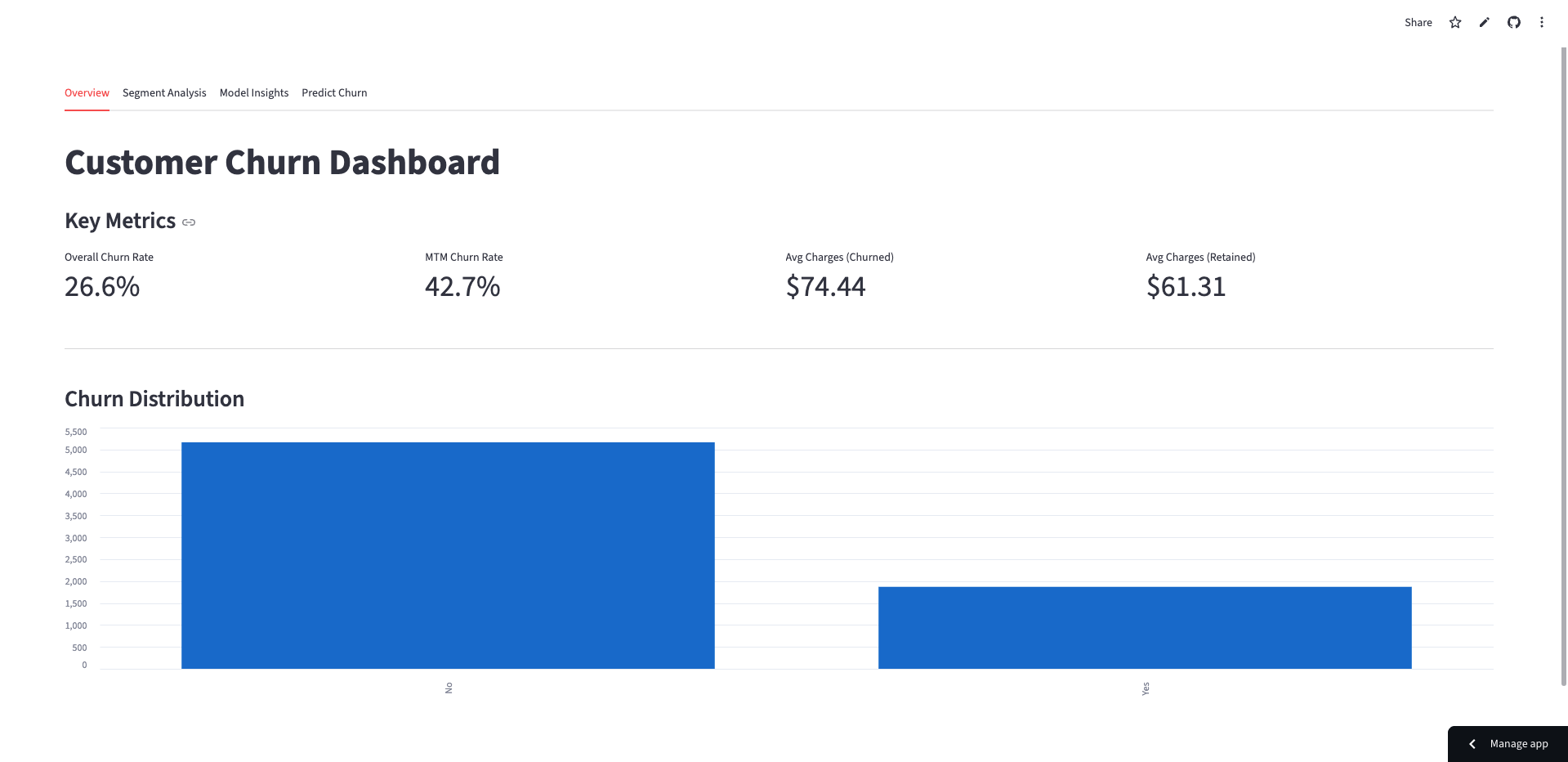
- • Overall churn rate
- • Month-to-month contract churn rate
- • Average monthly charges
- • Churn distribution
Segment Analysis
- • Churn by tenure group
- • Churn by internet service
- • Churn by payment method
Model Insights
- • Performance comparison between Logistic Regression and Random Forest
- • Explanation of high-impact churn drivers
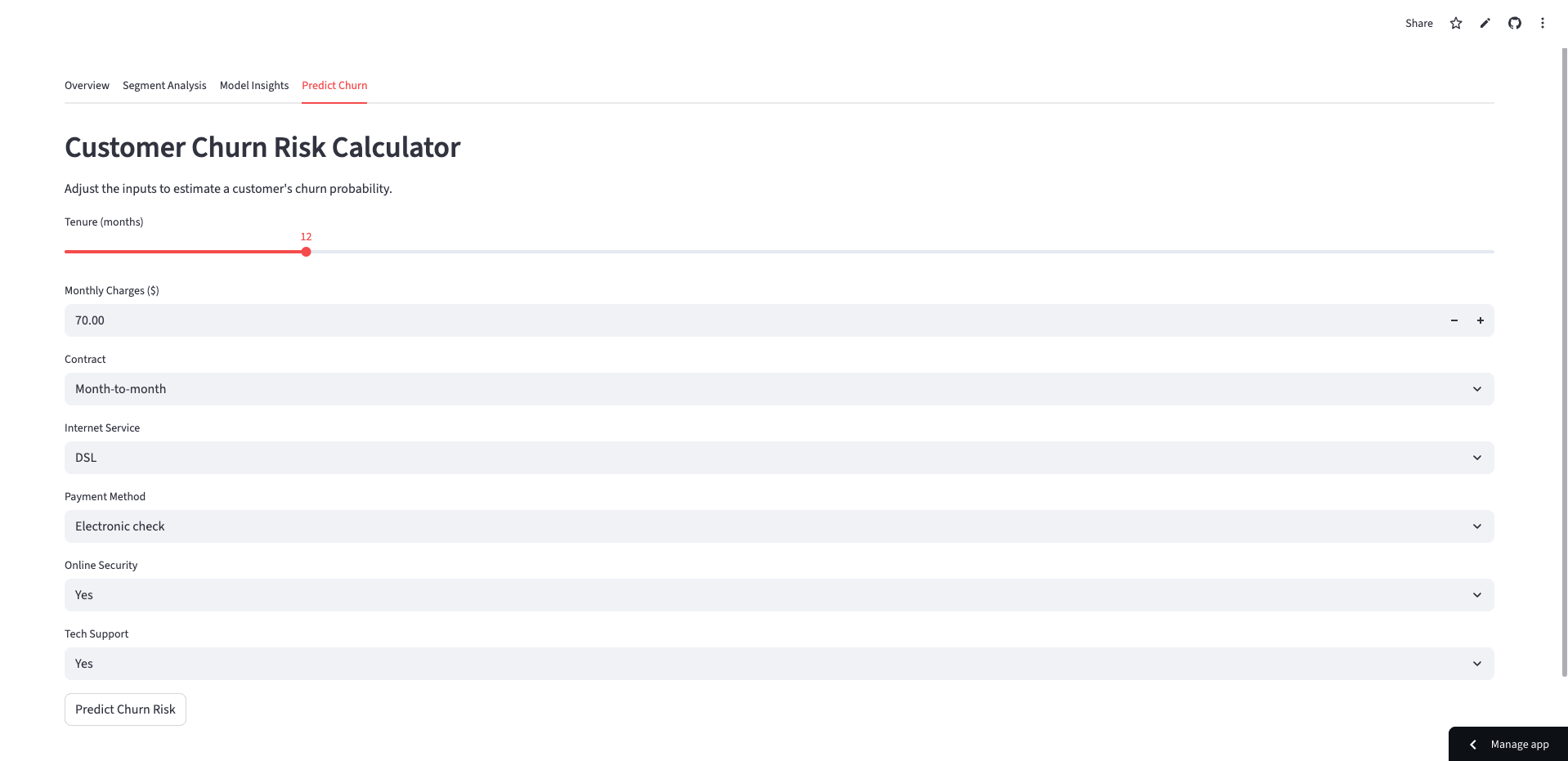
Predict Churn
- • A live prediction tool where users can input customer details and instantly receive a churn probability.
This makes the project hands-on and business-ready.
Results
The models revealed significant drivers of churn, including:
- Contract type (month-to-month customers are most likely to churn)
- Tenure (lower tenure strongly correlates with churn)
- Internet service type
- Monthly charges and billing preferences
Performance Summary
- Logistic Regression achieved ~79% accuracy and 0.83 ROC-AUC
- Random Forest achieved ~78% accuracy and 0.82 ROC-AUC
The deployed app enables real-time churn risk scoring, dynamic exploration of customer segments, and clear insight into retention opportunities.
Dashboard Preview
Overview Dashboard
High-level view of key churn metrics including overall churn rate, month-to-month churn rate, average charges comparison, and churn distribution visualization.
Segment Analysis
Deep dive into churn patterns by customer segments including tenure groups, internet service type, and payment methods.

Model Insights
Side-by-side comparison of machine learning model performance with metrics including accuracy, recall, F1 score, and ROC-AUC.
Churn Risk Calculator
Interactive tool allowing users to input customer characteristics and instantly calculate churn probability based on the trained model.
Prediction Output
Real-time churn probability result displayed after submitting customer details, enabling immediate risk assessment.

Tech Stack
Languages and Tools
- Python
- Pandas, NumPy, Scikit-Learn
- Streamlit
- Matplotlib, Seaborn
- Jupyter Notebook
- Joblib